


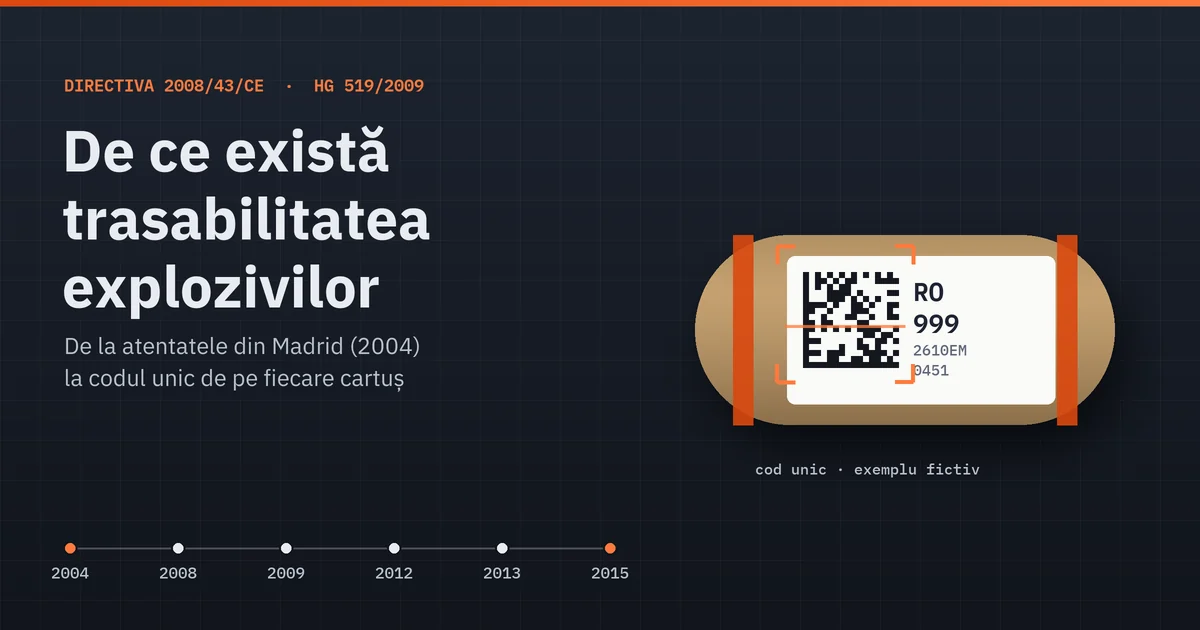
Why do I have to scan every cartridge? If you work with explosives for civil uses, you know the routine: every cartridge, every detonator and every box has a code, and the code is scanned on entry to the warehouse, on exit and on use. It looks like red tape. It isn't. Behind it lies one of the darkest days in Europe's recent history, and a question that, in 2004, nobody could answer quickly: where did the dynamite come from?
11 March 2004: dynamite from a mine in Asturias
On the morning of 11 March 2004, between 7:37 and 7:40, ten bombs exploded on four commuter trains entering Madrid on the same line from Alcalá de Henares: at Atocha station, on Calle Téllez (about 800 metres from Atocha), at El Pozo del Tío Raimundo station and at Santa Eugenia station. Three further devices failed to explode.
191 people died on the trains and almost 2,000 were injured — the figures established by the Spanish court in its judgment of 31 October 2007. The final death toll reached 193: a police officer killed on 3 April 2004, when the perpetrators blew themselves up in a flat in Leganés, and a woman injured at Atocha who died in 2014, after ten years in a coma. It was the deadliest attack in Spain's history.

One of the bombs, found intact in a bag, contained around 10 kg of Goma-2 ECO dynamite — an explosive made in Spain for mining — surrounded by nails and screws. The investigation led to the Conchita mine in Asturias, in northern Spain. The court found that the explosive had been stolen from the mine and had reached the attackers through José Emilio Suárez Trashorras, a former miner, sentenced in 2007 to 34,715 years in prison for supplying it.
One detail says a lot: for the explosive that detonated on the trains, the experts could not establish with certainty even the brand. The link to the mine was made from the unexploded bomb and from explosive found later. The lesson for the industry was simple and uncomfortable: a cartridge without an identity of its own cannot be traced. You may know which batch entered a mine, but not which piece left it, when, and through whose hands.
How the European Union responded
Two weeks after the attack, on 25 March 2004, the European Council adopted a declaration on combating terrorism. Among the measures, EU leaders called for terrorist groups to be deprived of the “tools of their trade” and for the security of firearms, explosives and bomb-making equipment to be strengthened.
In July 2005, the European Commission proposed measures on the security of explosives, detonators and firearms — storage, transport, production, detection. In November 2007 came a communication dedicated to the security of explosives, which led to the EU Action Plan on Enhancing the Security of Explosives, adopted by the Council on 18 April 2008.

At the same time, the Commission built on an older rule. Directive 93/15/EEC of 5 April 1993, which had harmonised the market in explosives for civil uses, already required companies in the sector to have a system that tells them at any moment who holds the explosives. What was missing was a single, European way of identifying each individual piece. That is how Commission Directive 2008/43/EC of 4 April 2008 came about.
The reason given in the directive is practical: unique identification makes it possible to trace an explosive from the factory to its final user, so as to prevent misuse and theft and to help the authorities find out where lost or stolen explosives came from. The directive does not mention Madrid — but it describes exactly the problem of 2004.
- 200411 March — the Madrid attacks. On 25 March, the European Council calls for tighter security of explosives.
- 2005July — the European Commission proposes measures on the security of explosives, detonators and firearms.
- 20084 April — Directive 2008/43/EC: a unique code on every explosive and records along the whole chain. 18 April — the EU Action Plan on the security of explosives.
- 200928 April — HG 519/2009: Romania transposes the directive (Monitorul Oficial No 328 of 18 May 2009).
- 201222 February — Directive 2012/4/EU postpones the deadlines: the IT systems needed more time than expected.
- 20135 April — unique marking becomes mandatory for manufacturers and importers.
- 20155 April — data collection and record-keeping become mandatory for all operators, including those who use explosives.
- 201620 April — Directive 2014/28/EU replaces Directive 93/15/EEC; Directive 2008/43/EC remains in force. In Romania, HG 197/2016 refers to HG 519/2009 for traceability.
- TodayEvery explosive has a code, and every one of its movements is kept for 10 years.
The deadlines moved only once. Originally, the directive was to apply from 5 April 2012. The industry asked for time to put secure IT systems in place, so Directive 2012/4/EU postponed marking by one year, to 5 April 2013, and data collection by three years, to 5 April 2015 — precisely so that everyone in the supply chain could set up electronic tracking. At the same time, fuses, safety fuses and percussion caps were removed from the system, being considered low-risk.
What Directive 2008/43/EC actually requires
Marking. Manufacturers, importers and those who assemble detonators mark every explosive and every smallest packaging unit with a unique code. Distributors who repackage explosives must make sure the new packaging also carries the code. The code has two parts: one readable with the naked eye and one read by a scanner.

- The human-readable part: the manufacturer's name and an alphanumeric code consisting of two letters for the country of production or import (RO for Romania), three digits for the production site — assigned by the national authority — and the unique product code, with the logistics information set by the manufacturer.
- The electronic part: a barcode and/or a Data Matrix code that corresponds directly to the alphanumeric code.
- Where it goes: on every cartridge or sack, with an associated label on every box; on the shell of every detonator; on the spool of detonating cord and on the cord itself, every 5 metres; on canisters and drums. Passive electronic tags (RFID) are permitted in addition.

Record-keeping. Every undertaking in the explosives sector must have a data collection system that tracks the codes throughout the supply chain and the entire life cycle of the explosive, so that the holder can be identified at any time. In practice, the undertaking must:
- keep a register of all the codes, the type of explosive and to whom it was entrusted;
- record the location of each explosive while it is in its possession, until it is transferred to another undertaking or used;
- test its system regularly and protect the data against destruction, whether accidental or deliberate;
- keep the data for 10 years from delivery or from the known end of the explosive's life cycle, even if it ceases trading;
- provide the authorities, on request, with the origin and location of each explosive and name a person who can respond outside normal working hours as well.
What it means in Romania: HG 519/2009
Romania transposed the directive through Government Decision (HG) No 519 of 28 April 2009, published in the Monitorul Oficial (Romania's Official Gazette) No 328 of 18 May 2009. The Decision was later amended to incorporate the postponements in Directive 2012/4/EU as well, and was republished. You will find more on the subject on our blog.
- Who is responsible: all undertakings in the explosives sector must have the data collection system — not only manufacturers, but also distributors and companies that store and use explosives: quarries, mines, blasting contractors. Each is responsible for the stretch of the journey during which the explosive is in its hands.
- The register is kept both electronically and on paper, and the data is kept for 10 years. If the company ceases trading, the documents are handed over within 15 days to the structures of the Ministry of Internal Affairs.
- The authorities: production site codes are assigned by the Ministry of Internal Affairs, which also monitors compliance with the record-keeping obligations. Marking breaches are established by the territorial labour inspectorates, and record-keeping breaches by the Romanian Police.
- Fines, according to the text of the Decision: between RON 5,000 and RON 10,000 for the lack of a data system, a register or data retention; between RON 2,000 and RON 10,000 for marking breaches.
What a company gains, beyond the law
Traceability is mandatory, but a company that does it well gains more than peace of mind during inspections:
- Accurate stock, item by item. You know exactly what you have in each warehouse, with no discrepancies discovered only at stocktaking.
- A shortfall shows up the same day. A cartridge that went out and was not used no longer goes unnoticed until the end of the month.
- Stress-free inspections. When the police ask about a code, the answer comes within minutes, with its full history.
- The register writes itself. The data comes from the scans; it is not copied out by hand and does not get lost between notebooks.
- Clear accountability. Every goods-out movement has a name, a time and a place of use.

How Explosives Traceability helps you
The Explosives Traceability software turns an obligation into a routine that takes a few seconds. You import the XML file the supplier sends with the explosives, and the shotfirers scan the codes with the mobile terminal on goods in, goods out and use. The data reaches the web portal, where you see the stock in each warehouse, who took out what and where it was used, and the register is generated from the scans. The data is kept with us, with daily backup and at least 10 years of history.

Want to see what it costs for your number of warehouses and terminals? You will find the plans on our pricing page, and for a quote or a demonstration, write to us on our contact page.
Frequently asked questions
Do I have to scan every cartridge, or is the box code enough?
The law requires you to be able to say at any moment where each explosive is. As long as a box moves whole, its associated label links it to the cartridges inside. From the moment the box is opened and the cartridges go their separate ways, each cartridge must be tracked by its own code.
How long must data on explosives be kept?
10 years from delivery or from the known end of the explosive's life cycle, even if the company ceases trading. In Romania, when a company ceases trading, the documents are handed over within 15 days to the structures of the Ministry of Internal Affairs.
What fines does a company risk if it does not keep records?
In Romania, under HG 519/2009, the lack of a data collection system, a register or data retention is punishable by a fine of between RON 5,000 and RON 10,000, established by the Romanian Police. Marking breaches are penalised separately, by the territorial labour inspectorates.
Are there explosives that fall outside the system?
Yes: explosives delivered unpackaged or in pump trucks that pump them directly into the blast hole, explosives manufactured at the place of use and used immediately, ammunition, fuses, safety fuses and percussion caps.
Can I keep the register in electronic form only?
Not in Romania: HG 519/2009 requires the data, including the unique codes, to be recorded and kept both electronically and on paper. A good IT system gives you both: the data from the scans and a register ready to print.
Sources
- Commission Directive 2008/43/EC of 4 April 2008 — EUR-Lex
- Commission Directive 2012/4/EU of 22 February 2012 — EUR-Lex
- Council Directive 93/15/EEC of 5 April 1993 — EUR-Lex
- Directive 2014/28/EU (Articles 15 and 51) — EUR-Lex
- European Council Declaration on combating terrorism, 25 March 2004 — Council of the EU, doc. 7906/04
- Commission Communication COM(2005) 329 on the security of explosives, detonators and firearms — EUR-Lex
- Council conclusions on the CBRNE agenda (referring to the Action Plan of 18 April 2008) — Council of the EU, doc. 16980/12
- Romanian Government Decision No 519/2009 — our blog (Monitorul Oficial No 328 of 18 May 2009)
- Romanian Government Decision No 197/2016, Article 29 — legeaz.net
- The Madrid attacks of 11 March 2004 — Wikipedia
- The verdict of 31 October 2007 — Al Jazeera
- José Emilio Suárez Trashorras, the convicted former miner — elDiario.es